
 Home > Achievement > 2025 Research Project List > Application Evaluation of Taro Diversified Processing Raw Materials Home > Achievement > 2025 Research Project List > Application Evaluation of Taro Diversified Processing Raw Materials |
Application Evaluation of Taro Diversified Processing Raw Materials
This study evaluated seven domestic cultivars of betel nut taro (Colocasia esculenta L.) for fresh corm physicochemical properties, starch thermal characteristics, and frozen taro cube quality to identify cultivars suitable for processed food development. Analyses were conducted on corms harvested at 10 and 12 months, measuring crude fiber, crude protein, amylose content, and moisture. Taro flour was prepared to determine gelatinization properties, water soluble index(WAI), and swelling power, while frozen taro cubes were assessed for water distribution via LF-NMR, texture profile analysis (TPA), freeze-thaw stability, and sensory attributes. Results showed significant differences among cultivars in crude fiber, protein, amylose, and moisture, with harvest age notably affecting protein and amylose contents. Cultivar L3-8 exhibited high fiber, protein, and starch content; cooking increased elasticity and chewiness but also induced greater color change, making it suitable for high-nutrition products. M-1 had high protein and starch with soft texture and minimal color change, suitable for varied texture applications. N2-2, with high protein, low starch, soft texture, and stable color, is promising for senior-friendly or low-sugar foods. O-3, with high cohesiveness and stable color, is appropriate for mashed taro products. Starch analysis showed O-3 and P-1 had the lowest gelatinization temperature range and enthalpy, moderate WAI and swelling power, uniform granules, and low energy requirement for gelatinization, indicating potential for powder- or mash- based products. Frozen taro cube evaluation revealed that L3-8 had optimal freeze-thaw stability and a Q-elastic texture, while N2-2 and M-1 exhibited low shrinkage and soft texture, achieving the highest sensory acceptability. Overall, the study successfully identified cultivars with distinct physicochemical and textural traits suitable for taro mash and frozen taro product development, providing a scientific basis for diversified utilization of domestic betel nut taro.
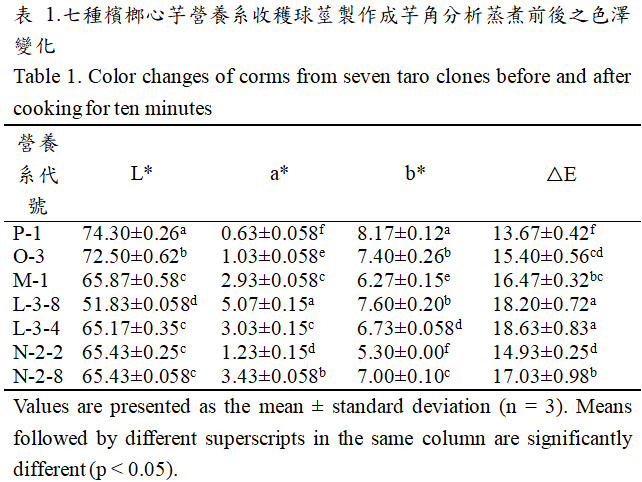 ▲Fig. 1.Thermal properties of different taro starch groups. |
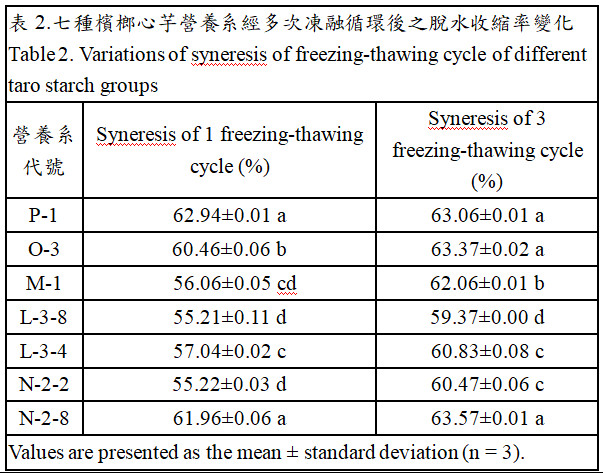 ▲Fig. 2. Variations of syneresis of freezing-thawing cycle of different taro starch groups |