
 Home > News > Water and Energy Saving for High-Quality Production: The Optimal Irrigation Model for Greenhouse Oriental Melons Home > News > Water and Energy Saving for High-Quality Production: The Optimal Irrigation Model for Greenhouse Oriental Melons |
Water and Energy Saving for High-Quality Production: The Optimal Irrigation Model for Greenhouse Oriental Melons
In the face of intensifying global climate change and frequent extreme weather events such as droughts and heavy rainfall, Taiwan's agricultural water resources are facing severe challenges. To help farmers cope with increasingly unstable water supplies and improve greenhouse cultivation efficiency, the Taiwan Seed Improvement and Propagation Station (TSIPS) of the Ministry of Agriculture has collaborated with National Chung Hsing University to successfully establish the "Optimal Irrigation Model for Greenhouse Oriental Melons". This model covers the entire growth period from seedling to field cultivation. By precisely calculating crop water requirements, it not only saves about 20% of water compared to traditional management models but also maintains fruit quality and even enhances sweetness. This provides a new water-saving, energy-saving, and high-quality production solution for the domestic melon industry.
TSIPS stated that Oriental melons, commonly known as Meinong melons (such as the popular 'Chiayu' variety), have large leaves and vigorous transpiration. Traditional greenhouse cultivation mostly relies on farmers' experience or scheduled irrigation, which often leads to over-watering or under-watering, resulting in wasted water resources or compromised fruit quality. To solve this dilemma, the research team applied the FAO56 method (crop coefficient - reference evapotranspiration) to accurately estimate the water demand of melons at various growth stages. Experimental results show that under a full irrigation model during the summer and autumn crops, the average water requirement for a single plant over its entire growth period is about 23.2 liters. By implementing a deficit irrigation strategy after fruit setting, water consumption can be reduced by 19.3% to 24.0% compared to traditional wet management.
TSIPS further pointed out that precise, reduced irrigation not only achieves water-saving goals but also has positive effects on fruit quality. Data shows that melons produced using the optimized irrigation model maintain standard fruit weight and flesh thickness. Furthermore, under moderate water stress, there is even a trend of increased fruit sweetness, dispelling farmers' concerns that reducing water would cause a significant drop in yield. This model not only eliminates the uncertainty of traditional experience-based irrigation but also significantly improves irrigation water productivity through data-driven management.
To promote this technology, TSIPS has authored a special article included in the "Crop Irrigation Guidelines Manual" compiled by the Taiwan Agricultural Research Institute (TARI). The content includes recommended irrigation schedules for different growth stages and suggestions for water storage facility capacities, allowing farmers to easily follow the guidelines. The full text is available for download online (https://tinyl.io/CJ7v). Meanwhile, by holding the demonstration, TSIPS facilitated communication between researchers and farmers in production areas, practically demonstrating the effectiveness of water-saving cultivation. TSIPS emphasized that it will continue to promote smart and precision agriculture technologies, assisting farmers in implementing effective water resource utilization and achieving the goal of sustainable agricultural management amidst the challenges of climate change.
| Contact Person |
TSIPS Yi-Lung Chang |
TSIPS Liu, Ming-Chung |
| Office Tel. | 886-4-25825460 | 886-4-25825402 |
| E-mail: | niceyilung@tss.gov.tw | tzong@tss.gov.tw |
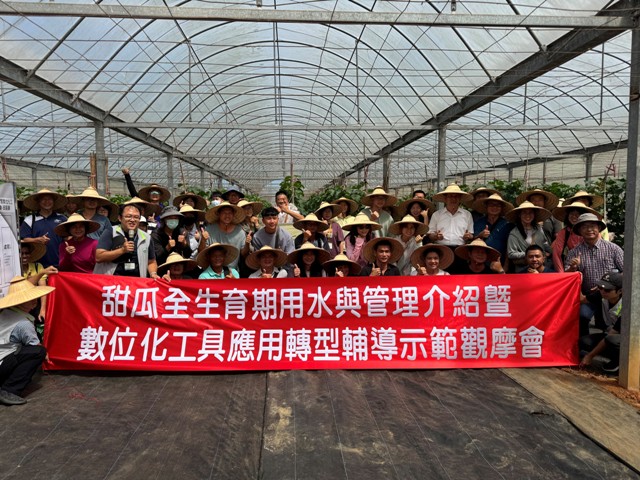 ▲Fig. 1. Image 1 Description: TSIPS held a field demonstration event, allowing farmers to physically observe the differences in melon plants before and after adjusting the irrigation model. |
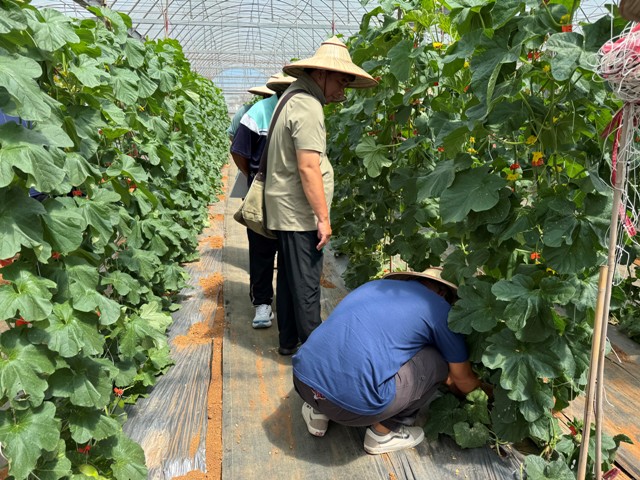 ▲Fig. 2. Image 2 Description: Farmers participating in the field demonstration intently observing the fruit quality of melons after irrigation adjustments. |
|
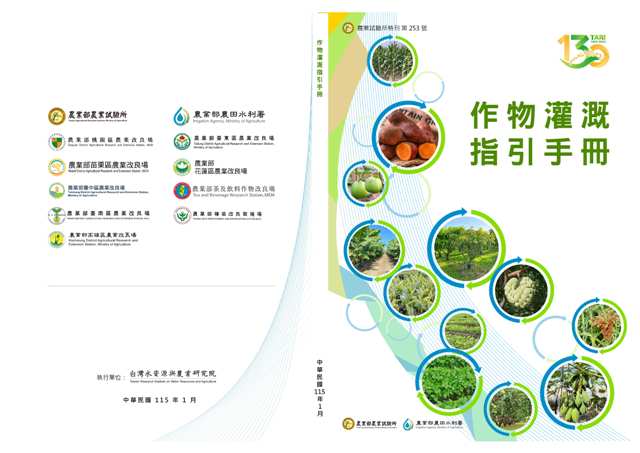 ▲Fig. 3. Image 3 Description: The melon irrigation guidelines authored by TSIPS have been published in the "Crop Irrigation Guidelines Manual" and can be downloaded in full at https://tinyl.io/CJ7v. |