
 Home > Achievement > 2026 Research Project List > Study on Tomato Rootstock Resistance to Bacterial Wilt and Implementation of Field Management Strategies in Seedling Nurseries Home > Achievement > 2026 Research Project List > Study on Tomato Rootstock Resistance to Bacterial Wilt and Implementation of Field Management Strategies in Seedling Nurseries |
Study on Tomato Rootstock Resistance to Bacterial Wilt and Implementation of Field Management Strategies in Seedling Nurseries
Single plants of the third generation (G3) with confirmed high resistance to Ralstonia solanacearum were harvested separately. Seeds from lines EG195, EG203, EG219, Eggplant Rootstock No. 302, Fengshan No. 3, and KS2018 were collected to serve as the fourth-generation (G4) materials for rootstock disease resistance testing (Figure 1).
To achieve resistance gene stacking in core eggplant rootstock germplasm, the G3 single plant EG195 was used as the maternal parent, and EG203, EG219, Eggplant Rootstock No. 302, Fengshan No. 3, and KS2018 were used as pollen donors for hybridization. A batch of $F_1$ hybrid seeds was successfully obtained (Figure 2), which will be included in subsequent inoculation trials to evaluate whether a resistance stacking effect is conferred.
The initial bacterial wilt (R. solanacearum) inoculation trial was conducted in June this year. Susceptible control cultivars began displaying disease symptoms 7 days post-inoculation (dpi) (Figure 3). Disease incidence data of the tested materials will continue to be monitored and recorded.
Based on literature screening, SSR primers eme05B09 and emf11N23 (Khapte et al., 2018) exhibited polymorphism in PCR amplification. The resulting PCR products were sequenced, and the retrieved sequence information was aligned against the Eggplant Genome Database (https://eggplant.kazusa.or.jp/index.html). The sequence of eme05B09 showed the highest similarity to >Sme2.5_00446.1. Using this target fragment sequence as a template, generic primers were designed. Following PCR amplification, the products were sent for sequencing. However, sequence alignment for SNP discovery yielded no informative results.
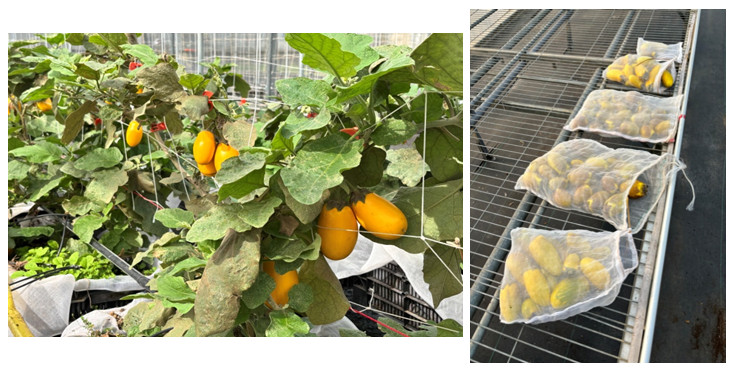 ▲Figure 1. Generation 4 (G4) materials derived from highly Ralstonia solanacearum-resistant G3 single plants. Harvested seeds include lines EG195, EG203, EG219, Eggplant Rootstock No. 302, Fengshan No. 3, KS2018, and Tainan No. 1. |
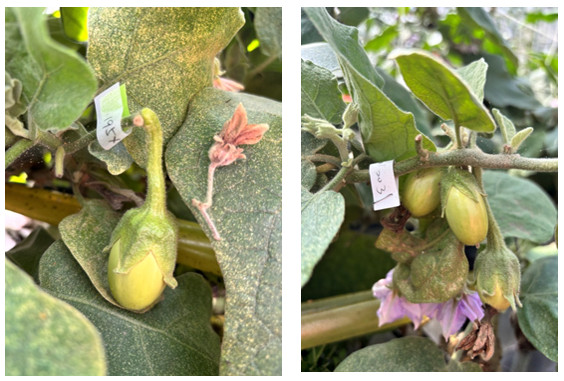 ▲Figure 2. Hybridization scheme using line EG195 (G3) as the maternal parent and highly resistant lines as pollen donors. Cross-pollination was performed to generate $F_1$ hybrid materials for resistance gene stacking (pyramiding). |
|
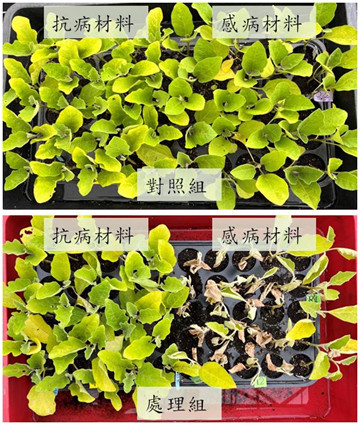 ▲Figure 3. Disease response of eggplant rootstocks for tomato grafting at 7 days post-inoculation (dpi) with Ralstonia solanacearum. Susceptible materials (right) exhibited symptoms in over 60% of plants, whereas resistant materials (left) remained asymptomatic. Disease incidence was recorded at 7, 14, 21, and 28 dpi. |