
 Home > Achievement > 2026 Research Project List > Study on Functional Microbiomes for Disease Resistance in Tomatoes Home > Achievement > 2026 Research Project List > Study on Functional Microbiomes for Disease Resistance in Tomatoes |
Study on Functional Microbiomes for Disease Resistance in Tomatoes
Tomato cultivation often suffers yield losses due to pests and diseases, and the frequent occurrence of global warming and extreme weather further intensifies production instability. This project aims to establish an evaluation method for screening microbial resources that can promote tomato root growth and enhance broad-spectrum disease resistance, thereby accelerating the identification of beneficial strains for tomato growth and pest/disease control. Meanwhile, the selected superior microbial strains will be applied in the field to verify their growth-promoting effects and disease resistance performance on tomato seedlings, expecting to provide more microbial resources and biological control solutions for tomato cultivation. In the preliminary execution of 2026, microorganisms were isolated from the rhizosphere soil of rootstock confirmed to be disease-resistant through inoculation with Ralstonia solanacearum, and plant growth-promoting trait evaluations—such as nitrogen fixation, phosphate solubilization, siderophore production, and ACC deaminase activity—were completed for candidate strains. Concurrently, antagonism tests (Figure 1) were conducted using the Ralstonia solanacearum Ping-Qie isolate as an indicator strain, successfully screening out 3 superior strains with significant growth-promoting and bacterial wilt-antagonistic potential (195 x Yongzhuang-2, 195 x 302-8, and H7996-3, and their 16S rRNA molecular identification was completed. In addition, tomato seedling growth promotion tests were conducted to evaluate the promoting effects of the newly screened strains on the shoot (Figure 2) and root growth of tomato seedlings, expecting to establish a standardized evaluation model for the application of functional microbiomes through these analyses
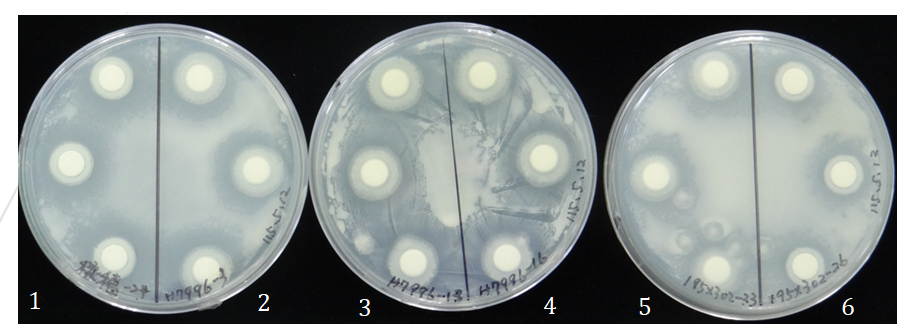 ▲Figure 1. Evaluation of the antagonistic activity of bacterial strains isolated from the rhizosphere soil of disease-resistant rootstock against Ralstonia solanacearum. The Ping-Qie isolate of Ralstonia solanacearum served as the indicator bacterium to test the antagonistic activity of each candidate strain. The candidate strains are as follows: 1: Jiasong-24; 2: H7996-1; 3: H7996-13; 4: H7996-16; 5: 195 x 302-33; 6: 195 x 302-26. |
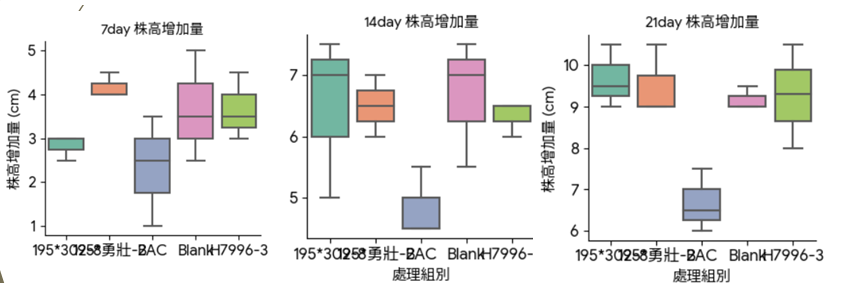 ▲Figure 2. Effects of different microbial treatments on the height increment of tomato plants. |