
 Home > Achievement > 2026 Research Project List > Establishment of Techniques for Phytoplasma Detection and Classification and Investigation on Phytoplasma Pathogen in Seeds of Important Crops Home > Achievement > 2026 Research Project List > Establishment of Techniques for Phytoplasma Detection and Classification and Investigation on Phytoplasma Pathogen in Seeds of Important Crops |
Establishment of Techniques for Phytoplasma Detection and Classification and Investigation on Phytoplasma Pathogen in Seeds of Important Crops
- Primer pairs targeting non-16S rRNA regions for the identification of 16SrII group phytoplasmas
Phytoplasmas are primarily classified based on the 16S rRNA gene; however, a single gene provides limited resolution for distinguishing closely related phytoplasmas. Therefore, in addition to the 16S rRNA gene, this study compiled primer pairs targeting the rp, secY, tuf, and imp gene regions for the identification of 16SrII group phytoplasmas commonly found in Taiwan. These primers will serve as analytical tools for improving the accuracy of phytoplasma identification in subsequent studies (Fig. 1). - First report of a phytoplasma infecting buckwheat in Taiwan
To evaluate potential phytoplasma hosts and transmission risks in agricultural ecosystems, a preliminary survey was conducted to detect suspected phytoplasma infections in weeds. In a grassland, Bermuda grass, perennial peanut, Monochoria vaginalis, and Emilia sonchifolia exhibited typical phytoplasma-associated symptoms, including little leaf and witches’ broom-like symptoms. Nested PCR and sequencing analyses confirmed that the detected phytoplasmas were closely related to previously reported phytoplasma strains (Fig. 2).
In addition, buckwheat plants (Buckwheat, Fagopyrum esculentum Moench) growing in a green manure crop field near the symptomatic weeds, where sunn hemp, buckwheat, and sunflower were cultivated, exhibited phyllody and virescence, typical symptoms of phytoplasma infection. Approximately 5% of the buckwheat plants showed these symptoms. Nested PCR and sequencing analyses confirmed that the symptoms were associated with phytoplasma infection, representing a phytoplasma disease not previously reported in buckwheat in Taiwan. This study provided the first evidence that buckwheat in Taiwan is infected by a ‘Candidatus Phytoplasma aurantifolia/citri’ -related strain belonging to the 16SrII-A subgroup, and the findings were published in Plant Disease (Fig. 3).
As the cultivated area of buckwheat continues to increase and the crop is commonly used as a rotational or winter cover crop, buckwheat may serve as a potential reservoir host for phytoplasmas and their insect vectors, thereby increasing the risk of pathogen persistence and transmission in agricultural fields.
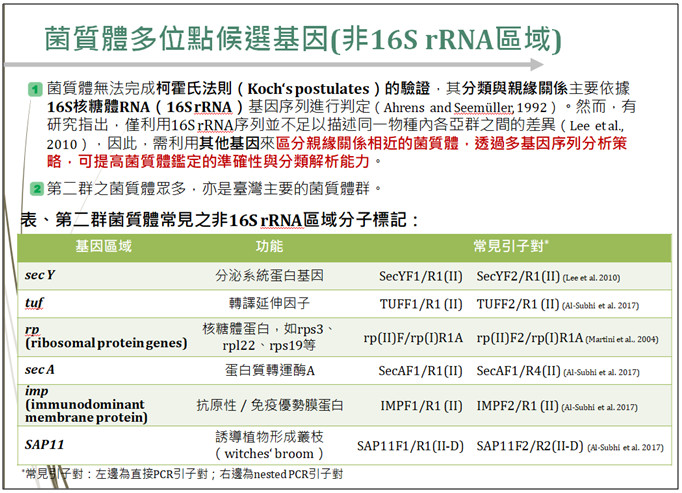 ▲Figure 1. Primer pairs targeting non-16S rRNA regions for the identification of 16SrII group phytoplasmas. |
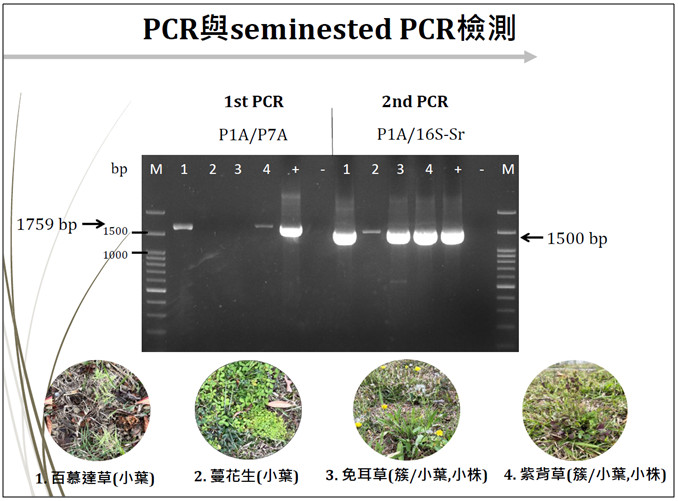 ▲Figure 2. Detection and survey of suspected phytoplasma infections in weeds. |
|
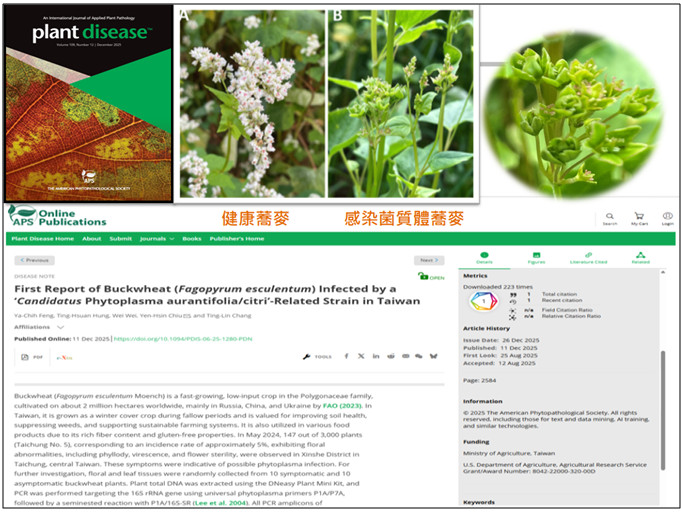 ▲Figure 3. First report of a phytoplasma Infecting buckwheat in Taiwan. |