
 Home > Achievement > 2026 Research Project List > Development of Molecular-Assisted Identification Technology for Pear Varieties Home > Achievement > 2026 Research Project List > Development of Molecular-Assisted Identification Technology for Pear Varieties |
Development of Molecular-Assisted Identification Technology for Pear Varieties
1.Translation and Archiving of the ISO 13495 Document:
This project has completed the full translation and archiving of ISO 13495, "Foodstuffs —Principles of selection and criteria of validation for varietal identification methods using specific nucleic acid" The work strengthens the scientific basis and objectivity of plant variety rights examinations and enhances breeders' confidence in and willingness to participate in the plant variety protection system.
2.Collection and Inventory of Pear Varieties, Establishment of DNA Extraction Procedures, and Preservation of Pear Samples:
Information on domestically bred and commercially available pear varieties was compiled, and relevant experimental materials were collected. DNA extraction procedures were established using both automated extraction systems and the CTAB method, producing DNA of sufficient quality for subsequent analyses. Pear samples were preserved through cryogenic storage, freeze-drying (Figures 1 and 2), and DNA preservation methods to ensure the long-term storage of genetic resources.
3.Application of Publicly Available SSR Molecular Marker Information to the Experimental Materials of This Project:
Using publicly available simple sequence repeat (SSR) molecular marker information, genetic analyses were conducted on the experimental materials included in this project.
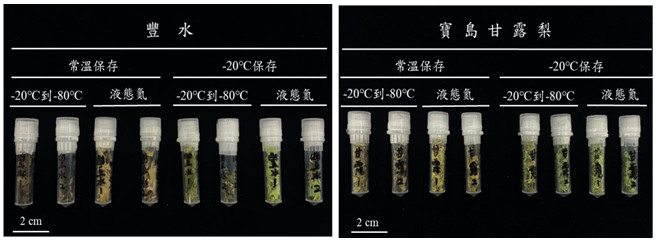 ▲Figure 1. Storage condition of freeze-dried pear leaf samples. |
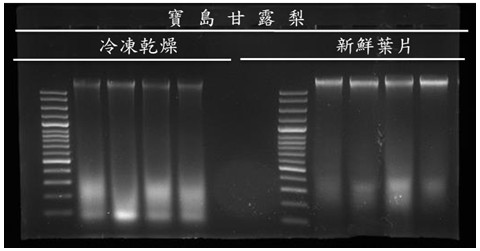 ▲Figure 2. Agarose gel electrophoresis analysis of DNA quality from fresh and freeze-dried leaves of 'Baodao Ganlu' pear. |
|
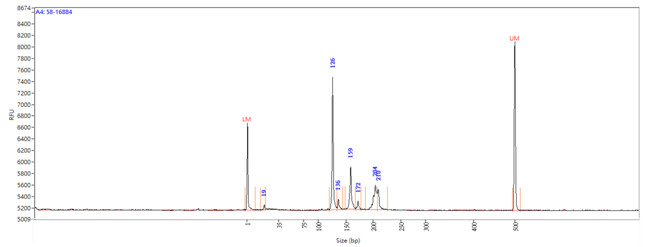 ▲Figure 3. Results of capillary electrophoresis analysis. |
||