


- Carbon Footprint Assessment of Domestic Kabocha Squash Utilizing the 'Agricultural e-Bazhua' Management System
- Execution of the Force Project - Research and Development of Indigenous Cereal Crop Processing Technology
- Optimization of production techniques for traditional fiber crops in the aboriginal tribes
- Establishment of meteorological parameters and crop production loss information for flint corn waterlogging in Taichung
- Optimization and diffusion of onion healthy seedling cultivation technology by vertical bed frame in response to strong winds and rainfall in Hengchun area
- Investigation of Transmission Pathways of Grapevine Viral Diseases and Establishment of a Virus-Free Planting Material System in Taiwan
- Construction of Environmental Verification System and Standards for Cucurbit Vegetables Nurseries
- The Promotion of Healthy Germplasm Conservation and Propagation Systems for Taro and Ginger
- Research on the New Development Trend of Seed Treatment Technology
- Establishment of Techniques for Phytoplasma Detection and Classification and Investigation on Phytoplasma Pathogen in Seeds of Important Crops
- Establishing Detection Techniques for Internationally Important Seed-transmitted Tobamoviruses in Cucurbit Crops
- Establishment of a Production and Application Model for Healthy Germplasm of Commercial Anthurium Cultivars
- Development of Molecular-Assisted Identification Technology for Pear Varieties
- Establishment of Molecular Techniques for Rose Variety Identification
- Study on Tomato Rootstock Resistance to Bacterial Wilt and Implementation of Field Management Strategies in Seedling Nurseries
- Genetic Dissection of Luffa Resistance to Fusarium Wilt and Marker-Assisted Identification of Rice Varieties
- Study on Functional Microbiomes for Disease Resistance in Tomatoes
- Development of Key Technologies for Tissue Culture-assisted Seed Selection
- Development of Molecular Marker for Melon Resilience Breeding
- Research on Germplasm Maintenance and Industrial Application of Vegetative Propagation Crops
- Research on Genetic Resources and Plant New Variety DUS Testing Techniques Management and Application of the Economical and Special Crops in Taiwan
- Next-generation Ark of Agriculture and Forestry Germplasm - Germplasm Regeneration of Important Cross-Pollinated Crops.
- Establishment of Organic Seed Production and Supplying System for Grains and Vegetable Crops
- Breeding of Adapted Bulbous Flower Cultivars
- Breeding of heat-resistant and high-quality tomato varieties
- High Quality Breeding in Tomato.
- Breeding of New Papaya Varieties for Net House Production
- Evaluation of Processing Characteristics of Domestic Taro Materials and Development of Ready to-Eat Products
- Promote the Industrialization of Precise Strawberry Seedling Hardening Modules
- Enhancement of the Testing and Monitoring System for Genetically Modified Crops in the Central Region of Taiwan and the Import Channel
- Reinforcing Taiwan's Engagement in International Seed Testing Method Validation and Technical Collaboration
 Home > Achievement > 2026 Research Project List > Evaluation of Processing Characteristics of Domestic Taro Materials and Development of Ready to-Eat Products Home > Achievement > 2026 Research Project List > Evaluation of Processing Characteristics of Domestic Taro Materials and Development of Ready to-Eat Products |
Evaluation of Processing Characteristics of Domestic Taro Materials and Development of Ready to-Eat Products
Four taro clonal lines (P-1, O-3, O-7, and N-2) were selected as experimental samples, with commercially available taro used as the control. The samples were subjected to two pre-drying pretreatments: freezing treatment (FT) and gelatinization–freezing pretreatment (G). After pretreatment, frozen taro strips were thawed in a 30°C incubator for 2 h prior to drying. During the drying process, sample weight was recorded at 30-min intervals, and drying curves were established based on changes in sample moisture content. The results showed that the drying rate of all taro clonal lines gradually decreased as drying proceeded, whereas samples subjected to gelatinization–freezing pretreatment exhibited a higher drying rate than those receiving direct freezing treatment. This phenomenon may be attributed to gelatinization-induced softening of tissue structure, which reduced internal moisture diffusion resistance and consequently improved drying efficiency.
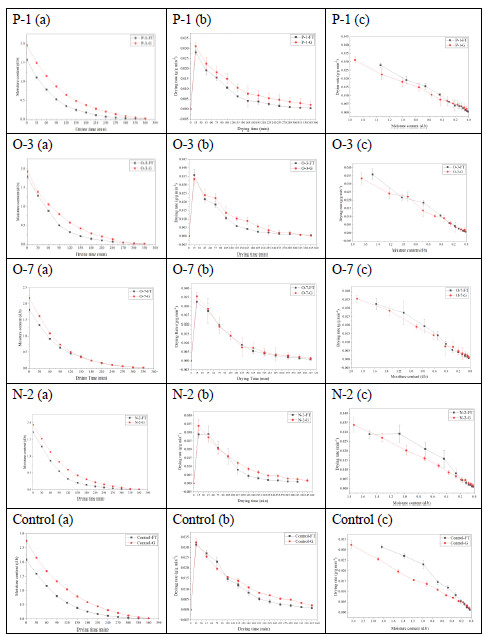 ▲Figure 1. Effects of different taro clonal lines and treatment methods (FT, G) on drying rate |