


- Carbon Footprint Assessment of Domestic Kabocha Squash Utilizing the 'Agricultural e-Bazhua' Management System
- Execution of the Force Project - Research and Development of Indigenous Cereal Crop Processing Technology
- Optimization of production techniques for traditional fiber crops in the aboriginal tribes
- Establishment of meteorological parameters and crop production loss information for flint corn waterlogging in Taichung
- Optimization and diffusion of onion healthy seedling cultivation technology by vertical bed frame in response to strong winds and rainfall in Hengchun area
- Investigation of Transmission Pathways of Grapevine Viral Diseases and Establishment of a Virus-Free Planting Material System in Taiwan
- Construction of Environmental Verification System and Standards for Cucurbit Vegetables Nurseries
- The Promotion of Healthy Germplasm Conservation and Propagation Systems for Taro and Ginger
- Research on the New Development Trend of Seed Treatment Technology
- Establishment of Techniques for Phytoplasma Detection and Classification and Investigation on Phytoplasma Pathogen in Seeds of Important Crops
- Establishing Detection Techniques for Internationally Important Seed-transmitted Tobamoviruses in Cucurbit Crops
- Establishment of a Production and Application Model for Healthy Germplasm of Commercial Anthurium Cultivars
- Development of Molecular-Assisted Identification Technology for Pear Varieties
- Establishment of Molecular Techniques for Rose Variety Identification
- Study on Tomato Rootstock Resistance to Bacterial Wilt and Implementation of Field Management Strategies in Seedling Nurseries
- Genetic Dissection of Luffa Resistance to Fusarium Wilt and Marker-Assisted Identification of Rice Varieties
- Study on Functional Microbiomes for Disease Resistance in Tomatoes
- Development of Key Technologies for Tissue Culture-assisted Seed Selection
- Development of Molecular Marker for Melon Resilience Breeding
- Research on Germplasm Maintenance and Industrial Application of Vegetative Propagation Crops
- Research on Genetic Resources and Plant New Variety DUS Testing Techniques Management and Application of the Economical and Special Crops in Taiwan
- Next-generation Ark of Agriculture and Forestry Germplasm - Germplasm Regeneration of Important Cross-Pollinated Crops.
- Establishment of Organic Seed Production and Supplying System for Grains and Vegetable Crops
- Breeding of Adapted Bulbous Flower Cultivars
- Breeding of heat-resistant and high-quality tomato varieties
- High Quality Breeding in Tomato.
- Breeding of New Papaya Varieties for Net House Production
- Evaluation of Processing Characteristics of Domestic Taro Materials and Development of Ready to-Eat Products
- Promote the Industrialization of Precise Strawberry Seedling Hardening Modules
- Enhancement of the Testing and Monitoring System for Genetically Modified Crops in the Central Region of Taiwan and the Import Channel
- Reinforcing Taiwan's Engagement in International Seed Testing Method Validation and Technical Collaboration
 Home > Achievement > 2026 Research Project List > Research on the New Development Trend of Seed Treatment Technology Home > Achievement > 2026 Research Project List > Research on the New Development Trend of Seed Treatment Technology |
Research on the New Development Trend of Seed Treatment Technology
- Development of Long-Term Protective Technology for Vegetable Crop Seed Treatment
Bacterial fruit blotch (BFB) of cucurbits is a significant global disease affecting cucurbitaceous crops. The pathogen of BFB, Acidovorax citrulli (Acit), can spread through rainwater, irrigation water, and seeds/seedlings. Applying antibiotics is one of the main methods for controlling BFB in cucurbits. This project tested the optimal conditions for seed treatment by using four coating agents of methylcellulose, sodium alginate, xanthan gum and gum arabic combined with five chemical bactericides of streptomycin, validamycin A, oxolinic acid, kasugamycin and Tiviant (fosetyl-aluminium + isotianil). The results showed that kasugamycin treatments at 10X, 20X, and 50X levels exhibited the best antibacterial activity, but kasugamycin negatively delayed cucurbit seed germination and reduced germination rate. While oxolinic acid treatments at 10X, 20X, and 50X levels and streptomycin treatments at 20X and 50X levels showed slightly less antibacterial activity than kasugamycin, they had no negative impact on the final germination rate of cucurbit seeds.
- Development of Seed Treatment Technology for High Temperature Adaptation and Long-Term Storage
For seeds with good intrinsic germination capacity, at optimal temperatures (20℃, 25℃), the germination potential is already fully realized, and additional osmotic priming treatments do not provide significant benefits. The only exception is the 'Red Sun' variety, which has a naturally lower germination capacity, where seed priming still showed an enhancing effect on the germination rate. At 30℃, H202 priming treatment effectively promotes the germination rate of the 'Golden Jumbo' and 'Red Sun' onion varieties, while 10 mM Betaine treatment simultaneously enhances the germination rate of the '706' variety. The '708' variety, on the other hand, exhibits inherently higher temperature tolerance at 30℃.Under the high-temperature stress of 35℃, germination is inhibited across all onion varieties, and the '708' variety shows particularly high sensitivity to 35℃. However, 20 mM Betaine treatment can simultaneously boost the germination rates of the '706' and '708' varieties, though it is unable to fully counteract the inhibition caused by the high-temperature stress. Storage trial results indicate that H202 priming does not compromise the post-storage germination rate within a six-month period. The effects of Betaine treatments on storage have not yet been experimentally verified this year and require future testing.
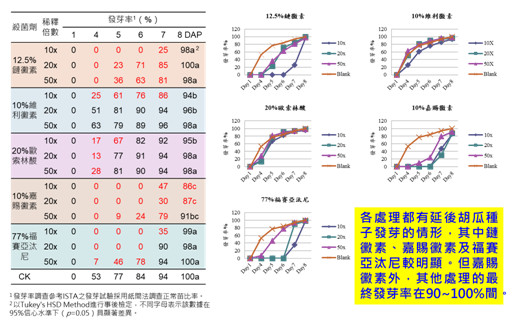
▲Figure 1. Daily germination of cucumber seeds treated with methylcellulose and different fungicides. |
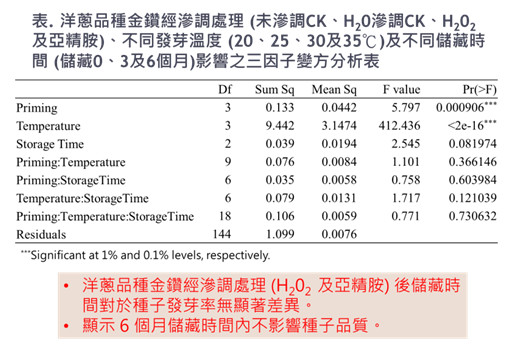 ▲Figure 2. A three-factor variable analysis of the effects of conditioning treatment (unconditioned CK, conditioned CK with H2O, H2O2, and spermidine), different germination temperatures (20, 25, 30, and 35°C), and different storage times (0, 3, and 6 months) on the Golden Diamond onion variety. |