2025 Research Project List

During the seedling stage this year, Daily Light Integral (DLI) was introduced as the primary trigger for irrigation. This approach effectively addressed the operational challenges of weight-based methods and the inability of scheduled irrigation to adapt to fluctuating climatic conditions, thereby providing flexibility in irrigation timing. Verification trials demonstrated that this method maintained the growth potential of melon seedlings post-transplantation into the field.Regarding field cultivation management, a melon water status assessment model was established. By integrating leaf physiological indicators (e.g., stomatal conductance) with meteorological parameters, the model achieved an accuracy ranging from 71.0% to 90.1%, providing growers with an effective tool for rapid daily irrigation decision-making. Furthermore, in the application of water management and crop coefficients (Kc), results validated that under the FAO56 full irrigation model, the average total water requirement per plant during the summer-autumn season was approximately 23.2 liters. Implementing deficit irrigation strategies reduced water consumption by 19.3% to 24.0% compared to traditional management practices, while maintaining comparable fruit quality, thus demonstrating the efficacy of optimized irrigation in water-saving cultivation. Finally, the research outcomes were successfully disseminated through a demonstration workshop titled "Introduction to Melon Growth-Cycle Water Management and Digital Tool Application for Transformation Guidance." This event facilitated knowledge exchange between producers and researchers, effectively promoting techniques such as crop coefficient estimation and precision water management, providing a viable reference for the future of water-efficient melon production.
.jpg) ▲Table. 1. Evaluation of Irrigation Indicators for Melon Seedlings |
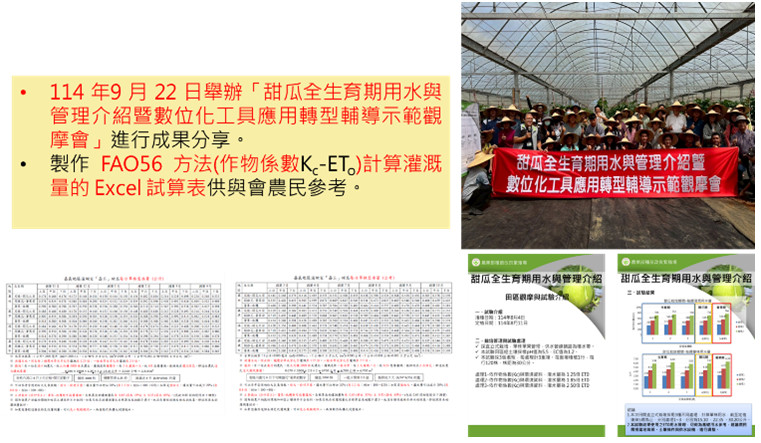 ▲Fig. 1. Demonstration and Extension Workshop on Optimized Irrigation Models for Melons |