


- Verification Of onion Healthy Seedling Cultivation Adaptation Technology in Pingtung and Tomato High Temperature and Drought Technology under Heavy Rainfall Situation in Tainan
- Carbon Footprint Assessment of Local Dried Shiitake Mushrooms
- The Promotion of Conservation systems and the assessment of applications for indigenous heirloom foxtail millet(Setaria italia)
- Establishment and Verification of the Optimal Irrigation Mode for Melon in Protected Facility
- Establishment of Important Virus Detection Method for Grape in Taiwan
- Restablishment of Domestic Seed Corn and Sorghum Production System
- Construction of Environmental Verification System and Standards for Cucurbit Vegetables Nurserie
- The Promotion of Healthy Germplasm Conservation and Propagation Systems for Taro and Ginger
- Establishment of Techniques for Phytoplasma Detection and Classification and Investigation on Phytoplasma Pathogen in Seeds of Important Crops
- Study on Tomato Rootstock Resistance to Bacterial Wilt and Implementation of Field Management Strategies in Seedling Nurseries
- Development and Application of Molecular Markers Associated with Anti-fusarium Wilt on Luffa and Drought-tolerance and Other Important Traits on Maize
- Study on Functional Microbiomes for Disease Resistance in Tomatoes
- Development of Key Technologies for Tissue Culture-assisted Seed Selection
- Development of Molecular Marker for Melon Resilience Breeding
- Research on germplasm maintenance and industrial application of vegetative propagation crops
- Germplasm Development and Application of Cattleya Alliance and Agapanthus.
- The Promotion of Aboriginal Beans Crops Seed Saving System
- Research on Genetic Resources and Plant New Variety DUS Testing Techniques Management and Application of the Economical and Special Crops in Taiwan
- Next-generation Ark of Agriculture and Forestry Germplasm - Germplasm Regeneration of Important Cross-Pollinated Crops.
- Establishment of Organic Seed Production and Supplying System for Agriculture and Hortculture Crops- Buckwheat, Tomato and Okra
- Techniques Development for Adaptable Varieties of Bulb Flowers Breeding
- Selection and Application of Scion and Rootstock Combinations for Summer Cucurbit Vegetables
- Establishment of a Heat-Tolerance Selection Index and Breeding of Tomatoes
- High Quality and Stress Tolerance Breeding in Tomato.
- Study on Variety Optimization and Breeding Techniques for Summer Cucurbitaceae Vegetables
- Breeding of New Papaya Varieties for Net House Production
- Research on the Development and Application of Diverse Food and Agriculture Teaching Materials of Potato
- Research on the Behavioral Intentions of Agricultural Social Responsibility
- Application Evaluation of Taro Diversified Processing Raw Materials
- Promote the Industrialization of Precise Strawberry Seedling Hardening Modules
- Enhancement of the Testing and Monitoring System for Genetically Modified Crops in the Central Region of Taiwan and the Import Channels
- Collaborative Exchange on DUS Testing Techniques of Plant Variety Rights and Seed of Trade Certification and Management System between Taiwan and UK
- Enhancing the Connection and Participation with Seed Testing Technology Related International Organization
 Home > Achievement > 2025 Research Project List > Research on the Behavioral Intentions of Agricultural Social Responsibility Home > Achievement > 2025 Research Project List > Research on the Behavioral Intentions of Agricultural Social Responsibility |
Research on the Behavioral Intentions of Agricultural Social Responsibility
This study conducted a questionnaire survey among participants of the Agricultural Academy courses, collecting 64 valid responses. Using the Importance-Performance Analysis (IPA) method, the study explored participants’ perceptions of the importance and willingness to act regarding the three dimensions of agricultural ESE (Environmental, Social, and Economic).The results indicated that non-conventional producers and farmers with Traceability Certification showed significantly higher levels of perceived importance and willingness to act in the environmental and social dimensions of agricultural ESE compared to conventional producers and those without certification. This finding confirms the correlation between farmers’ production models and their sustainability awareness. Furthermore, the IPA results indicated that several factors fell within the “Low Priority for Improvement” quadrant, including resource recycling and reuse, responsible land-use management, environmental benefits of eco-friendly farming, establishment of low-carbon production models, and soil quality improvement. Therefore, it is recommended that future course designs emphasize these “secondary improvement” items to strengthen participants’ understanding of agricultural sustainability concepts and encourage them to put sustainability principles into practice. Ultimately, this will contribute to achieving sustainable agricultural management and improving both social and environmental outcomes.
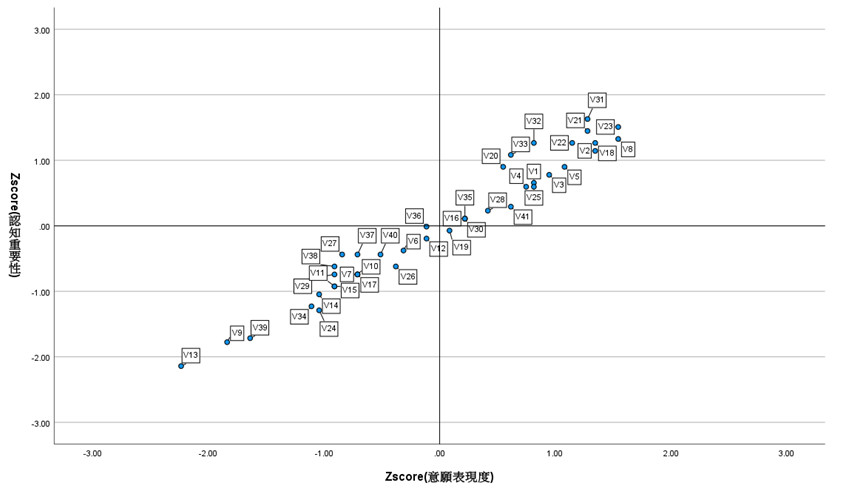
▲Fig1. IPA Matrix of Perceived Importance and Willingness to Act